
A self-repairing high speed door is an industrial door whose curtain automatically slots back into its guide rails after an accidental impact — without stopping production or needing a technician. If a forklift hits the curtain, it releases safely and then re-threads itself on the next open-close cycle. This "crash-out and self-recover" design is why high-traffic factories, cold stores and logistics warehouses prefer them over conventional shutters that jam or tear on impact.
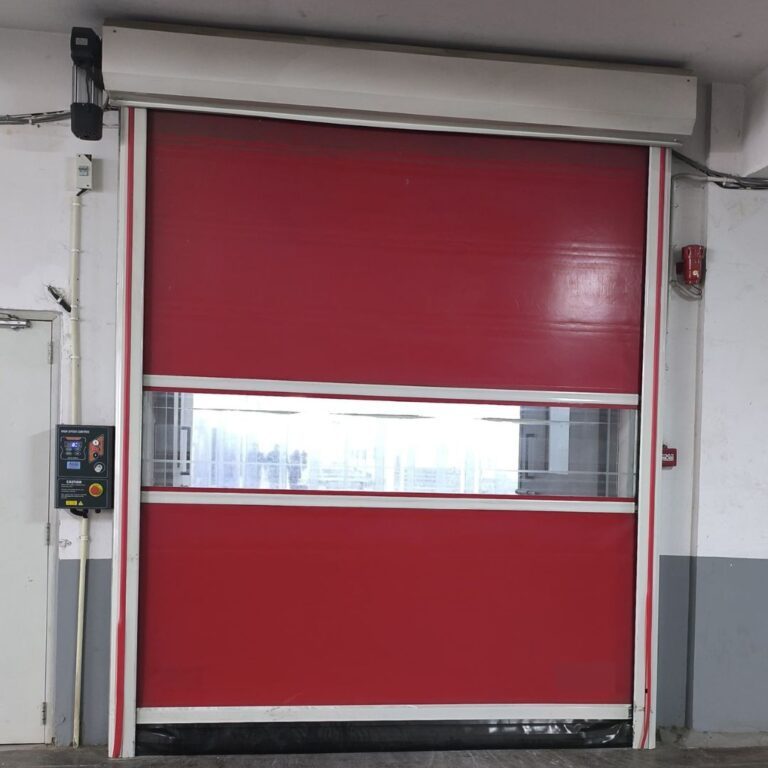
On a standard high speed door, a hard knock can pull the curtain out of its side guides, bending components and forcing a shutdown until someone repairs it. A self-repairing (also called "crash-out" or "break-away") door is engineered so the curtain edge is designed to pop out of the guide under impact, absorbing the force instead of resisting it. On the very next cycle, the top of the curtain automatically guides the edge back into the rail. Production keeps moving, and damage is avoided.
| Concern | Conventional high speed door | Self-repairing high speed door |
|---|---|---|
| After a forklift impact | Often jams, bends or tears; needs repair | Releases and re-threads automatically |
| Downtime | Production stops until fixed | Little to no downtime |
| Repair cost over time | Recurring parts and labour | Significantly reduced |
| Best for | Low-traffic openings | High-traffic, forklift-heavy areas |
These doors are most valuable anywhere vehicles pass through openings dozens or hundreds of times a day: warehouse loading areas, distribution centres, food and beverage plants, pharmaceutical facilities, cold storage, and automotive or manufacturing lines. In temperature-controlled environments they also help hold the seal, because fast opening and closing limits air exchange.
When comparing self-repairing doors, look at opening speed (faster cycles mean less air loss and smoother traffic flow), the curtain material and whether it suits your environment (dust control, cold rooms, wash-down areas), safety sensors and photocells, and the type of drive and controller. For openings exposed to wind or pressure differences, confirm the door is rated for your conditions.
A rolling shutter is built for security and closing off an opening at the end of the day. A high speed door is built for frequent, fast movement during the working day. If your opening sees constant forklift traffic and you care about speed, sealing and impact recovery, a self-repairing high speed door is the better fit. Many facilities use both — a high speed door for daytime flow and a shutter for overnight security.
It is an industrial high speed door whose curtain is designed to pop out of its guide rails on impact and then automatically re-thread itself on the next cycle, avoiding damage and downtime.
The flexible curtain edge releases from the guide under impact, and a guiding mechanism at the top of the door re-inserts it into the rails during the next open or close cycle — usually without any manual help.
For high-traffic openings with regular forklift movement, yes. The reduction in repair costs and production downtime typically outweighs the higher upfront price. For low-traffic openings, a standard door may be enough. Share your opening size and daily traffic for tailored advice.
Price depends on the opening dimensions, speed, curtain material, safety features and site conditions. Because every opening is different, it's best to share your requirements and get a specific quote rather than rely on a generic figure.
Warehousing and logistics, food and beverage, pharmaceuticals, cold storage, and automotive and general manufacturing — anywhere with heavy internal vehicle traffic and a need for speed, sealing or hygiene control.
Rudhar Group manufactures and installs industrial doors across Delhi NCR — Delhi, Gurugram, Noida, Faridabad, Ghaziabad and Bahadurgarh — and all over India, and has been doing so since 1998.
Rudhar Group has been manufacturing industrial doors, rolling shutters, gates and loading bay equipment since 1998, from our facility in Delhi NCR.
High speed doors manufactured by Rudhar operate at 1.5 to 3 metres per second.
We supply and install across Delhi NCR, Haryana, Punjab, Himachal Pradesh, Jammu & Kashmir, Uttar Pradesh, Madhya Pradesh and Rajasthan. Every unit is manufactured to the opening size supplied by the customer — share your site dimensions and location for a quotation.
If forklift impacts, downtime and repeat repair bills are a regular headache, a self-repairing high speed door pays for itself in uptime and protection. The right specification depends on your opening size, traffic and environment. Contact Rudhar Group for a site assessment and we'll recommend the right door for your facility.