
When specifying doors for a new warehouse or upgrading an existing one, the choice usually comes down to two options: a sectional overhead door or a rolling shutter. Both close the opening, but they behave very differently in terms of insulation, headroom, sealing and long-term cost. This comparison will help you choose correctly the first time.
A sectional overhead door is made of horizontal insulated panels hinged together. It rises vertically and then runs horizontally along tracks under the ceiling, sitting parallel to the roof when open.
A rolling shutter is made of interlocking slats that coil around a barrel above the opening. It occupies very little depth inside the building but leaves a visible roll and requires headroom above the lintel.
| Factor | Sectional Overhead Door | Rolling Shutter |
|---|---|---|
| Insulation | Excellent — foam-filled panels | Limited unless insulated slats used |
| Sealing | Very good — perimeter seals all round | Moderate — gaps at guides possible |
| Headroom needed | Low headroom options available | Needs space for the coil |
| Ceiling space used | Runs back under the roof | None — stays at the opening |
| Damage repair | Replace a single panel | Often requires curtain section replacement |
| Security | Good | Excellent (steel slats) |
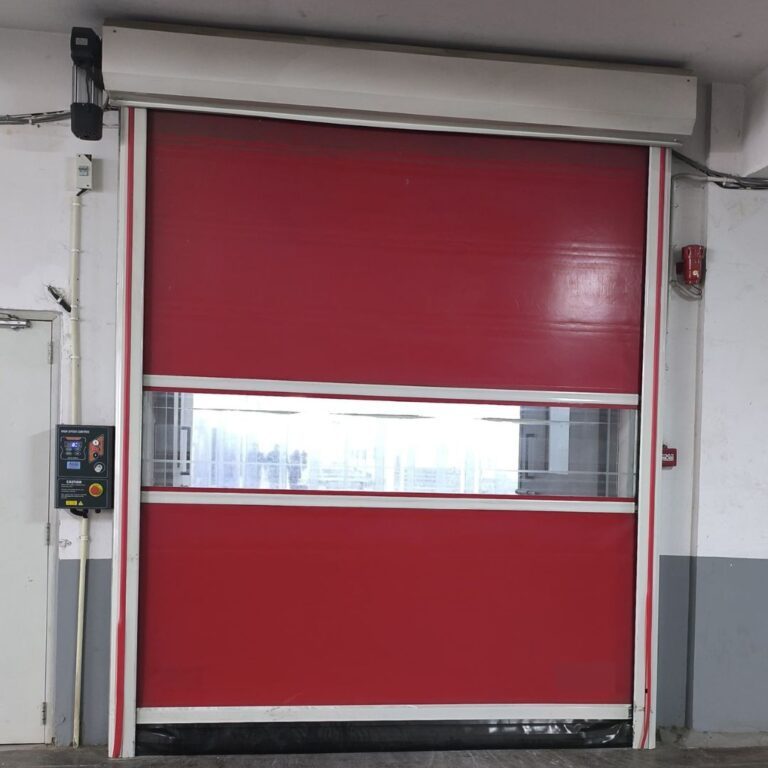
For high-traffic internal openings, neither may be ideal — a high speed door often outperforms both because it cycles in seconds and minimises air exchange. Many facilities use a combination: an insulated sectional door on the external dock, and high speed doors between internal zones.
A rolling shutter usually has a lower purchase price. But in a temperature-controlled building, the energy loss from poor sealing can exceed the price difference within a few seasons. Similarly, in a high-impact area, a sectional door's panel-by-panel repairability can be cheaper over its lifetime. Evaluate total cost of ownership — purchase, energy, maintenance and downtime — not just the initial quote.
Yes. Motorised operation with remote control, push-button, loop detector or sensor activation is standard for industrial sectional doors, along with safety photocells and anti-drop devices.
Both last many years with proper maintenance. The determining factor is usually the environment: corrosive or dusty atmospheres, coastal humidity and impact frequency affect lifespan more than door type.
Standard tracks need reasonable headroom above the opening, but low-headroom and high-lift track configurations exist for constrained buildings. A site survey determines the right track type.
Rudhar Group has been manufacturing industrial doors, rolling shutters, gates and loading bay equipment since 1998, from our facility in Delhi NCR.
High speed doors manufactured by Rudhar operate at 1.5 to 3 metres per second.
We supply and install across Delhi NCR, Haryana, Punjab, Himachal Pradesh, Jammu & Kashmir, Uttar Pradesh, Madhya Pradesh and Rajasthan. Every unit is manufactured to the opening size supplied by the customer — share your site dimensions and location for a quotation.
There is no universally better door — only the right door for the opening. Insulation and sealing point to sectional overhead doors; security and space constraints point to rolling shutters; heavy internal traffic points to high speed doors. Speak to Rudhar Group for a site survey and an honest recommendation based on your building, traffic and budget.