
In a cold storage facility, the doorway is the single largest source of thermal loss. Every opening cycle pulls in warm, humid air that the refrigeration system must then work to remove. The right door specification does not just keep the cold in — it directly reduces electricity consumption, prevents frost problems and protects product quality. Here is what to consider.
Air infiltration through an open doorway is driven by the temperature difference between inside and outside. In Indian conditions, a freezer room at −20°C facing an ambient of +35°C creates a very large driving force. Warm air rushes in at the top of the opening while cold air spills out at the bottom. The result is compressor load, frost accumulation, condensation on floors and, in the worst cases, ice buildup that jams the door itself.
Well-designed cold storage facilities rarely rely on a single door. They use layers:
Panel thickness and core material determine the thermal barrier. Deep-freeze applications need substantially thicker insulation than chiller rooms. Do not accept a chiller-grade door for a freezer.
Below freezing, moisture condenses and freezes at the door perimeter, gluing the door shut and tearing seals on opening. Heated frames, heated guides and heated gaskets prevent this. This is not an upsell — in a freezer, it is essential.
Gaps at the guide rails and floor let humid air migrate continuously, not just during opening. A properly sealed door with compression gaskets around the full perimeter eliminates this constant leak.
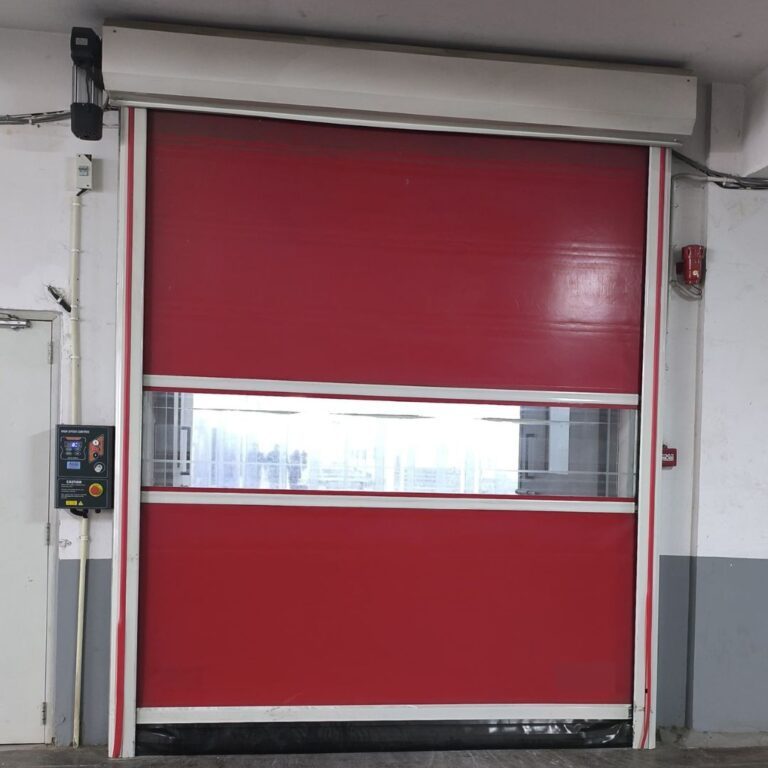
For rooms accessed many times a day, an insulated high speed door dramatically reduces the total open-door time. Read our complete guide to high speed doors for how they work and where they pay back fastest.
Forklifts and pallet trucks will eventually hit the door. Crash-tolerant designs that self-reset prevent the downtime and repair cost that follow every collision.
Inspect gaskets and seals regularly for compression set, tears and ice damage. Verify that heaters in frames and guides are working before every winter and during monsoon humidity. Check that the door closes fully and squarely — a door that closes 95% of the way is leaking 100% of the time.
No. Strip curtains reduce infiltration but do not replace an insulated door. They are a useful supplementary layer, especially in front of a high speed door in a busy aisle.
Warm humid air is reaching a sub-zero surface. Usual causes: a missing or failed frame heater, a worn perimeter gasket, or a door left open too long during operations. Fix the cause, not just the symptom.
An insulated sectional door at the dock with a dock shelter and leveler, backed by an insulated high speed door at the freezer entrance — so goods pass through a protected chain rather than a single opening.
Rudhar Group has been manufacturing industrial doors, rolling shutters, gates and loading bay equipment since 1998, from our facility in Delhi NCR.
High speed doors manufactured by Rudhar operate at 1.5 to 3 metres per second.
We supply and install across Delhi NCR, Haryana, Punjab, Himachal Pradesh, Jammu & Kashmir, Uttar Pradesh, Madhya Pradesh and Rajasthan. Every unit is manufactured to the opening size supplied by the customer — share your site dimensions and location for a quotation.
In cold storage, doors are refrigeration equipment. Specify insulation, heating, sealing and speed appropriate to the temperature class, and maintain them like the energy assets they are. Contact Rudhar Group for cold storage door solutions engineered for Indian ambient conditions and real operational traffic.