
In a pharmaceutical or food processing facility, a door is part of the contamination control strategy. It maintains pressure differentials between zones, prevents particulate migration, withstands aggressive washdown chemicals and stands up to audit. A door that merely opens and closes is not enough — here is what "clean room grade" actually means.
Every joint, screw head and ledge is a place where product residue and microorganisms can accumulate — and a place an auditor will look. Clean room doors use flush surfaces, sealed edges, coved corners and concealed fixings.
Stainless steel (typically 304 or 316 grade depending on the chemical exposure) resists corrosion from cleaning agents. Where a flexible curtain is used, it must be a washable, non-porous material that does not absorb moisture or harbour bacteria.
Perimeter gaskets must maintain a seal against the pressure differential, cycle after cycle, without permanent compression set. Doors used in pressurised suites need frames engineered to resist deflection under load.
Foot switches, elbow switches, wave sensors or automatic detection allow operators carrying materials — or wearing sterile gloves — to pass through without touching anything.
In airlocks and material transfer areas, door interlocks ensure both doors are never open simultaneously, preserving the pressure barrier. Interlock systems must include an emergency override for evacuation.
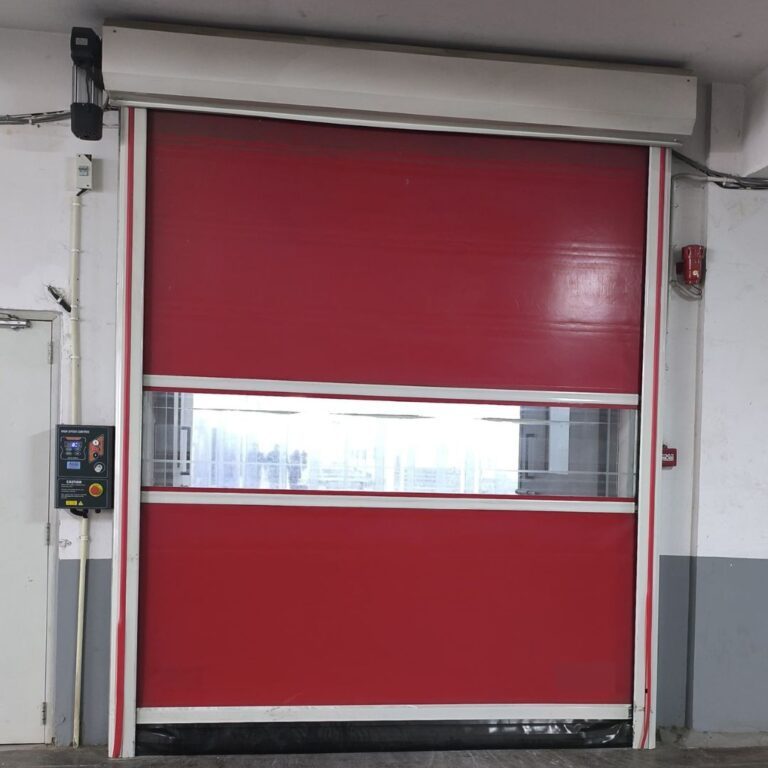
Inside a facility, an insulated, washable high speed door between production zones minimises the open time and therefore the volume of air exchanged. Fast cycling means the HVAC system recovers pressure quickly and cross-contamination risk drops. For frequently used internal openings, this is often the single highest-impact upgrade available.
GMP audits look for more than a clean-looking door. Be ready to show material certificates and surface finish specifications, cleaning and sanitisation procedures compatible with the door materials, maintenance and calibration records for automated doors and interlocks, and validation documentation where doors form part of a qualified system. Choose a supplier who can supply this paperwork — not just the hardware.
It depends on the chemicals used in cleaning and the process environment. Higher-chloride and more aggressive environments call for a more corrosion-resistant grade. Discuss your actual cleaning regime with the supplier rather than defaulting to the cheapest option.
Only if it is specifically built for the application — washable non-porous curtain, stainless or coated frame, sealed construction and appropriate pressure rating. A standard warehouse high speed door will not pass a GMP audit.
Wherever an airlock or pressure cascade must be preserved, interlocking is standard practice and is expected by auditors. Requirements depend on your facility design and the classification of the zones involved.
Rudhar Group has been manufacturing industrial doors, rolling shutters, gates and loading bay equipment since 1998, from our facility in Delhi NCR.
High speed doors manufactured by Rudhar operate at 1.5 to 3 metres per second.
We supply and install across Delhi NCR, Haryana, Punjab, Himachal Pradesh, Jammu & Kashmir, Uttar Pradesh, Madhya Pradesh and Rajasthan. Every unit is manufactured to the opening size supplied by the customer — share your site dimensions and location for a quotation.
Clean room doors sit at the intersection of engineering and compliance. Specify materials for your cleaning chemistry, seals for your pressure differentials, hands-free operation for your workflow, and documentation for your auditor. Contact Rudhar Group for hygienic doors, food industry doors and clean room entrance solutions built for GMP environments.